Combat Strategy |
by SocialRipple |
| Bookmarks to
Topics Covered: Terrain Hopping Using Ranged Attack with Melee Combat Spirits Using Defenders Trapping Your Opponent To Move, or Not to Move? The Castle is the Enemy |
Introduction: When in a game there a lot of different things to do, and sometimes it is hard making decisions on where to move your spirits, or what to cast if you have multiple spirits and a limited amount of energy. This article will hopefully help you understand these choices so you can see what works best in your situation. No game of SpiritWars will ever be the same. Each game you play will be different, and so there is no one way to play, or single way to play your spirits. However, armed with information on some strategies and tactics, you can learn how to play better in any situation. Terrain Hopping, as I call it, is moving a spirit with a range greater than one across the map while keeping it on its home terrain. On some maps you will enjoy a string of spaces that are all the same type of terrain, and that is very useful if it is in your favor, but more commonly your terrain is spaced out across the map. Just because a spirit has a move greater than one, you don’t have to move it to its maximum movement range each turn. If you have terrain spaced properly, a lot of the time by pacing your spirit, you can keep it on it’s home terrain most of the way across the map. Some turns you may need to move two or even three, if possible, spaces to keep on your terrain. Other turns you may move only one. If you must move off of your home terrain, there are a few times when it is better to make that move than others. When your opponent’s pieces have just been cast, and cannot act yet is one time, assuming you can get onto home terrain by the time they can get within attacking range. Using Ranged Attack with Melee Combat Spirits: Sometimes you end up with an archer in play as well as some spirits with an attack range of 1. If you move wisely, you can end up with a very deadly combination of attacks.
If you are going first, move a combat spirit onto it’s home terrain, with an archer behind it (preferably on home terrain, although that is not necessary). Whenever a spirit moves up to attack the combat spirit, the archer can weaken or kill it while protected by the combat spirit. Then move them together, with the archer staying behind the combat spirit. This will give the combat spirit an edge and keep the archer alive longer (but watch out for spirits with a move range of 2 or more, or you could misjudge and let them get to the archer). If you are going second, your archer can watch to see where they move, then jump back out of range and attack them, repeating this until they are. With a range of 2 or more, you can easily dance around their castle, avoiding their combat spirits while whittling away at the castle (1 or 2 points of damage a turn really adds up). Going either first or second, there are a few things you can do with your archers to make them more useful. Keep them behind a cursed space or deep water (if your opponent isn’t playing blue, that is). That way they will have to go around the obstacle and during that time you can be shooting them. Keeping an archer 3 spaces away from their castle can also be very cruel. With a range of two, that will allow you to shoot any spirit they put into play, and unless it has attack and move first turn, there is no way it can retaliate. Defenders are very useful if used correctly, and many times overlooked when compared to powerful combat spirits or damaging spells. A defender can be just as deadly to your opponent as a spirit with a large attack power. Even though they cannot harm your opponent’s castle, they can block spaces, damage opposing spirits with their blocking power, and all in all really mess up their plans. First, depending on the situation, most of the time you want your defender on it’s
home terrain, even if that puts it in a different location than that which would be ideal.
Remember, if it is taking damage every turn when blocking, ignoring that first point of
damage can make a big difference. Placing a Sacred Oak, or other defender with a range of 2, adjacent and to the rear of your castle, can have wonderful results (blocking any attacks on your castle). If it’s on it’s home terrain, you opponent may very well concede to save themselves the horror of dealing with such a setup. One of the best uses I have ever seen of defenders was very hard to do, but won the game once it was pulled off. Take a combat spirit, and move it adjacent to their castle. Next, place a defender on either side of it. Now, it is nearly impossible to attack the spirit, which is damaging the castle every turn. If you choose to play defensively, defenders are a must. Depending on the map, it is sometimes possible to create a vertical row of defenders, with archers placed behind it. As the opponent approaches, the archers will attack over the defenders. Then, once the opponent’s combat spirits are dead, the archers (whom usually have a 2 range) step over the defenders, moving in for the castle. If there is any sign of danger to the archers, they retreat back behind the defenders. Strategies such this require a lot of patience, but can win the game if done correctly. When moving in offensively, giving your opponent room to move or cast spirits is not acceptable if you expect victory. Trapping their spirits, or at least keeping them off their home terrain, is vital, and keeping them confined within a small part of the map can give you time to get your attack forces prepared while they deal with their predicament. If there is a limited amount of terrain favorable to your opponent, move your spirits onto it. That way, you are taking command of the situation and keeping them where you want them. Placing defenders on their terrain will have an equal effect. If you are attacking their castle, move all your spirits around it, even if they
Where and when to move is vital. This was covered partially in Terrain Hopping, but this section goes more in depth on placing spirits that use magic, and when to charge your opponent as opposed to defending your castle. Spirits with magic are best placed behind your castle and moved away from your opponent. This keeps them out of danger and they double as a scout for that area of the map, which will also give you the opportunity to place energy pieces on discovered friendly terrain. Now, of course, this doesn’t always work. You wouldn’t place your Thor way in the back, but usually the mage has little, if any, combat ability. Sometimes it is worthwhile to sacrifice a scout to learn more about the area surrounding your opponent’s castle. You may learn that he has an archer lurking behind his castle or find he has no real defense and that it is time to attack. If you find that your opponent has an archer, there are a number of ways to deal with it. Rushing with a number of spirits can overwhelm it, until you can finally reach it and kill it. Charging with a powerful spirit, which can survive multiple attacks from it (preferably with healing) can also work. If your opponent has more combat spirits than you, then it may be time to fall back to your castle. Move onto the most favorable terrain (either stay on yours, or keep them off their own), and do your best. Remember, while you are right by your home, it takes them both time and energy to move all the way over there to attack you! Finding your opponent prepared to take your attack can be worse than actually being attacked by them. Once you have done sufficient damage to them, you can slowly move in, remaining partially defensive while closing on their castle and killing whatever they have left. Always remember your goal. Above all else, your opponent’s castle is the enemy. Do
damage to it at every opportunity. Kill anything that can stop you from reaching your
goal, and sometimes you should destroy their Regardless of that spirits either player has in play, I guarantee that if you get his castle to 0 before he does it to you, you will win that game. Even if you suffer losses, always be watching the damage level of your opponent’s castle. So what if he manage to take out your favorite combat spirit? If it allows you to destroy his castle, let him kill whatever he want (short of your own castle, that is). Being ruthless and aggressive can surprise your opponent as well as hurt him before he is prepared. If you spend 5 or 6 turns getting your attack force together, he will have sufficient time to rally his defenses to stop you. If you begin attacking his castle as soon as you find it, he will struggle to hold you off while you move in yet more spirits. If you have a spirit with a move of 2 or even 3, it is not that hard to dance it around their castle, hitting him each turn while his slower spirits run in circles, never getting close enough to fight back. |

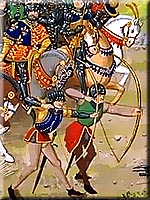 If you are going first, your archers have more
offensive options, but going second your archers can keep themselves alive more easily
while picking off your opponent.
If you are going first, your archers have more
offensive options, but going second your archers can keep themselves alive more easily
while picking off your opponent.  Placing
an archer behind the defender can be annoying, especially if the archer has a 3 range.
Placing
an archer behind the defender can be annoying, especially if the archer has a 3 range. cannot
do damage to it (scouts or spirits with a 0 attack power). Place energy and defender
spirits around their castle, preventing your opponent from activating any new combat
spirits. The key to this is not to kill any energy pieces they have that are adjacent to
the castle. They may be generating energy, but they are also occupying key entry locations
and keeping him from placing a potentially dangerous spirit in that space. Even if you are
doing minimal damage every turn, they cannot do anything, while you are free to move and
cast as you like, while they can only hope for a spell to aid them.
cannot
do damage to it (scouts or spirits with a 0 attack power). Place energy and defender
spirits around their castle, preventing your opponent from activating any new combat
spirits. The key to this is not to kill any energy pieces they have that are adjacent to
the castle. They may be generating energy, but they are also occupying key entry locations
and keeping him from placing a potentially dangerous spirit in that space. Even if you are
doing minimal damage every turn, they cannot do anything, while you are free to move and
cast as you like, while they can only hope for a spell to aid them. energy,
but all the while, have something damaging their castle. Even if it is only a single point
of damage per turn, that can be the difference between victory and loss.
energy,
but all the while, have something damaging their castle. Even if it is only a single point
of damage per turn, that can be the difference between victory and loss.