If a film director wanted to type-cast the role of a focused and slightly
eccentric game inventor, he might draft Randy Chase. As he sits and talks at
his dining-room table in Milwaukie, his
fingers pluck the table top as though reaching for invisible chessmen. His long
blond hair sweeps back in half-wild wisps. He wears broad, wire-rimmed glasses
with faintly tinted lenses. A thin gold band encircles his neck, above a cream-white
shirt with modest ruffles on the front.
The truth is, Chase actually is a focused and slightly eccentric game
inventor. However, though 'tis the season when most people in his industry are
shoveling slush piles of Christmas cash, this yuletide finds Chase very pissed
off.
On Oct. 25, Chase filed a lawsuit in federal court against Hasbro, one of the
world's biggest toy and game companies. Name an iconic game--Monopoly, Clue,
Scrabble, Battleship--and Hasbro probably owns it. The $4.2 billion company
churns out everything from Tonka trucks to Furbys to Mr. & Mrs. Potato Head
to Pokémon to Dungeons & Dragons. In the succinct words of one game-industry
insider, Hasbro is "gawd-awful huge."
Chase's suit charges this megalith with trying to steamroll his livelihood.
Specifically, it accuses Hasbro of violating the federal trademark Chase holds
on the name of SpiritWars, an online game he launched in December 1998. The
game is hardly a household word, but an incredibly loyal group of players has
gravitated to its strategic challenges and florid swords 'n' sorcery images.
 HAMMER OF THE GODS: Gamesmith Randy Chase says he found inspiration in this
scene from Jason and the Argonauts
HAMMER OF THE GODS: Gamesmith Randy Chase says he found inspiration in this
scene from Jason and the Argonauts
|
In early October, Chase learned that Hasbro's Seattle-based subsidiary Wizards
of the Coast, which revolutionized the industry in the '90s with the fantasy
card game Magic: The Gathering, planned a new version of one of its card games.
The name? The Spirit Wars.
"My reaction that first night was one of complete shock," Chase says now. "After
the shock passed, my most common feeling about it is anger. Either they were
totally irresponsible, making an incredibly stupid mistake, or they are just
so big that they don't care whose rights they infringe on."
In late November, the titanic toymaker fired back at the Milwaukie inventor
with a counter-suit, demanding that the court throw out Chase's claim and strip
him of his hard-won trademark on the game he created from scratch.
The David-vs.-Goliath nature of the battle raises questions about intellectual
property and corporate identity that have become more uncertain in the Internet
Age. But to Chase and his supporters in the sometimes densely odd subculture
of hardcore game-players, it's about more than that. It's also about the fate
of a lone inventor with anachronistic views on chivalry, culture and sportsmanship,
matched against a vast company that owns a huge swath of the American imagination.
 THE FAMILY that plays together, etc.: Randy and Jonathan Chase get wired
|
When it comes to games, Randy Chase is as serious as global warming. "I've
been a gamer ever since I was a kid," he says, recalling his upbringing in Winston,
a tiny town near Roseburg in southern Oregon. "My friends and I made up our
own games with baseball cards, rewriting the rules of Monopoly, that sort of
thing. I learned to play double-deck pinochle with my aunts and uncles by the
time I was a third-grader. When other kids were putting together models of cars,
I was doing models of Dracula, Frankenstein and Wolfman instead. In the '70s,
I went through a phase where I was into these really complex war games that
occupied the whole kitchen table and took three weeks to play. I know the difference
between a good game and a bad game."
In the '80s and '90s, he applied that knowledge reviewing software for a weekly
Oregonian column. He also started his own magazine, The Guide to Computer
Living, in 1984. The magazine featured acid-addled guru Timothy Leary as
a columnist, touting computers as "the new psychedelic" about a decade before
such views became hipster conventional wisdom.
Chase eventually decided that he knew enough about games to make his own. A
self-confessed CNN addict, Chase started out hammering code for a game that
let players run virtual presidential campaigns for Portland animation magnate
Will Vinton's now-defunct software company. That led to a gig designing a game
based on the '92 election for Garry Trudeau, creator of the popular political
comic strip Doonesbury.
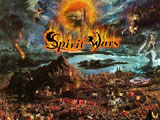 WORLD IN FLAMES! SpiritWars sends gods, ghosts and mystic warriors into battle.
|
Though the Doonesbury game received good reviews and is still used in
some college political-science classes, Chase found it an embittering experience.
He says he ran up against corporate execs in California who "had never played
a game in their lives." He also recounts fending off innumerable dumb ideas,
such as a cracked scheme to make Chinese fortune cookies a key component of
the game's design.
"It was just a creative nightmare," he says now.
The fiasco spurred him to work harder and fight for complete creative control.
Five years ago, Chase started doodling new plans. He'd always remembered a scene
from the 1963 movie Jason and the Argonauts in which Zeus (Irish actor
Niall MacGinnis) and Hera (Honor Blackman) manipulated mortal reality by moving
pieces on an Olympian game board. "I wanted to do a game that captured the feeling
of gods looking down on the world, moving the pieces around," he says.
The result was SpiritWars, an online strategy game similar to chess, checkers
and battlefield classics like Stratego. Two players face off on an online game
board featuring eight kinds of terrain. Because there are 426 different attacking
pieces and hundreds of possible game board arrangements, no two games can ever
be the same. The pantheon of pieces recalls role-playing games like Dungeons
& Dragons and reflects Chase's fascination with mythology, history and politics.
SpiritWars players can attack each other with everything from Hercules to Vlad
the Impaler to acid rain.
Since the game went online in '98, more than 250,000 games of SpiritWars have
been played. The combination of strategy, luck and fantastical whimsy proved
attractive to cerebral types turned off by the high-tech gore of many other
online games. There are about 200 serious SpiritWarriors at any given time;
Chase says a base of a few thousand regular paying players would ensure the
game's future.
Despite the devotion the game inspires among zealots, it remains a family affair.
Chase named his company, Kellogg Creek Software, for the trickle that runs through
his backyard. Chase's wife, Lyn, who neither knows how to play SpiritWars nor
wants to learn, acts as a maternal camp counselor for the game's junior players.
When a player too young to know better violates ground rules banning profanity
and trash-talk, he or she has to spend some quiet time online, chatting with
"Mom." Randy and his son Jonathan, a 17-year-old funk rock bassist with an elfin
presence and long, maritime-green hair, did the early R&D on SpiritWars
at the dining room table.
If this seems like an exceptionally down-home way to run a business in a globalized
age, that's mostly by design. Chase wants SpiritWars to be more than a diverting
strategic challenge. He designed the game to reflect values shaped by youthful
stints in the rock-and-roll, liberal-politics and freak-radio scenes of Portland
and Eugene. He hopes SpiritWars injects a subtle, quirky intelligence into computer
games' standard diet of virtual mayhem.
Each one of the 426 characters is illustrated with a carefully chosen piece
of classical, medieval or Renaissance art. Literary quotes and allusions lace
the game. "In a subtle way, we're introducing a little culture into the gaming
world," Chase says. "It's great to go into chat rooms and see 14-year-old kids
arguing about which Renaissance painter they like best."
A similar humane spirit informs the online "atmosphere" surrounding the game.
Devotees describe SpiritWars as a rarity: Profanity is forbidden and trash-talk
discouraged, women are protected from harassment and new players are nurtured.
For a war game, SpiritWars is incredibly civilized.
"This is the one and only place where I'd let my 6-year-old son sign on to
play," says Jay Sardi, a self-described gaming fanatic from Destrehan, La.,
who plays under the screen alias "The Slayer." Sardi says he and his wife, Pamela
("Honeydragon"), play a lot of SpiritWars.
Sharon Panas, a housewife and mother who lives in the agricultural foothills
of the Canadian Rockies south of Calgary, says the game offers her intellectual
satisfaction she might otherwise miss. She plays under the name "theREALunicorn."
"I'm the only person in my family who's interested in wizards and warlocks
and so forth," she says. "I don't have a lot of friends of the female persuasion
around here who share those interests, either. I'm sort of out on my own little
island."
Certainly, there are a lot of games on the Internet dealing with wizards and
warlocks, but Panas says she's tried them, only to spend almost as much time
fending off (mostly male) idiots as playing. With SpiritWars, though, it's a
different story. She says she was once called "a gender-specific name"--which
she declines to repeat--in a chat room; seven other players jumped to her defense
before she could reply.
"There's an ethic about the game that says, 'This is a place of intelligence,
let's keep it that way,'" she says. "Randy had a specific type of person he
envisioned as a player for this game, and he's done his best to make sure that
it attracts that crowd."
Chase may be interested in creative control and an elevated tone, but he's
not naive about the need to protect and promote his brainchild. In April 1998,
he applied for a federally registered trademark, an expensive bureaucratic obstacle
course many small companies never hazard. This July, the U.S. Patent and Trademark
Office finally awarded a trademark for "SpiritWars."
Chase has also tried to find a more advantageous online home for the game.
When it first went online, SpiritWars was part of a network run by Sierra, a
pioneering computer-games company. The Sierra network ended up mutating, a few
corporate mergers later, into a haven for simplistic e-versions of chess, checkers
and casino games. It was time for SpiritWars to move on. Earlier this year,
Chase began looking for new partners. Logically enough, he approached Wizards
of the Coast. After all, the Hasbro subsidiary makes Magic and Dungeons &
Dragons, probably the two most famous fantasy games in the world. This spring,
Chase says, he called several Wizards of the Coast managers in Seattle, trying
to interest them in SpiritWars. They said no.
"Randy approached them about picking up the game," says Stuart Cohen, one of
Chase's attorneys. "Six months later, they try and take the mark. Seems like
a hell of a coincidence."
The PacWest Center spires out of downtown Portland, a chrome and black-blue
office tower indebted to the Neo-Urban-Ugly school of architecture. On the 15th
floor, a corridor walled with seamless panels of blond wood greets visitors
to the Portland offices of Perkins Coie, the biggest law firm in the Northwest.
Perkins Coie represents Boeing, Amazon.com, the Seattle Mariners--and Hasbro.
Neither Hasbro nor its subsidiary will comment directly on Chase's lawsuit,
beyond saying they performed unspecified precautionary trademark checks before
rolling out The Spirit Wars. Attorneys from Perkins Coie failed to return numerous
phone calls and emails.
On Nov. 20, Hasbro filed its counter-suit. It says pretty clearly that the
toy giant thinks Randy Chase can go to hell.
Specifically, it alleges that the term "spirit wars" is a generic term used
in literature and folklore, and that Chase's trademark is thus illegally "descriptive"
of his product. Oddly enough, this assertion hasn't stopped Hasbro from using
a ™ symbol on its own logo for The Spirit Wars. In addition, Wizards of
the Coast has trademarked a number of literary terms; in 1995, for example,
the company registered the name "Arabian Nights." Market a game named after
the ancient tales of Scheherazad, Sinbad the Sailor and Ali Baba, and Hasbro
will see you in court.
Hasbro and its Wizards of the Coast subsidiary are also notorious for extremely
aggressive trademark policies, even cracking down on their games' most dedicated
fans when independent websites and 'zines overstep fair-use boundaries. Wizards'
website (www.wizards.com) includes an entire section outlining its trademark
rights, under the bold headline "Can You Spell I-N-F-R-I-N-G-E-M-E-N-T?"
Chase's own suit most likely hinges on two questions. First, what did Hasbro
or Wizards know and when did they know it?
"If it can be shown that Hasbro had actual knowledge that another game called
SpiritWars exists, it could be a powerful factor," says Anne Glazer, a Portland
trademark lawyer who has no connection to the case. "That could speak to the
intent of the defendant."
Given that the two games are dissimilar in all but name, the second question
is whether the games compete for the same customers. A similarity between brand
names can be legally OK, so long as it's not likely to confuse consumers.
"Hasbro will likely argue, 'You sell your product over the Internet, we sell
ours in stores,'" says Paul Havel, a trademark lawyer for Portland firm Miller
Nash. "They'll say they're totally different. Kellogg Creek will argue that,
well, no, we're targeting the same people."
To the extent that the dueling lawsuits demand that a court decide if SpiritWars
and The Spirit Wars could be competitors, they will delve into one of America's
most frenetic, esoteric and fast-growing subcultures. When it comes to games,
things aren't exactly like they were in Chess Club anymore.
In the '70s, Dungeons & Dragons changed games forever, offering millions
of would-be adventurers trapped in oppressive high schools, cluttered dorm rooms
and soul-killing jobs the chance to fight it out in an evolving world of magic,
combat and mystery. The Internet revolution of the '90s brought the same fictive
complexity online. "Massively multi-player" games like EverQuest (some call
it "EverCrack") allow thousands of players to wander rich virtual worlds simultaneously.
At 6 pm PST last Sunday, for example, an astonishing 71,755 people were playing
EverQuest.
The Web also turned out to be a hothouse in which a caste that had subsisted
in the social Siberia of the geek nation could burst into vigorous public life.
For millions of people, the word "game" is now a verb, as well as a noun.
Gamers pay the salaries of designers, programmers and marketers; they have
their own superstars and feuds. They also have their own specialist press, mostly
online. One such publication, Dailyradar.com, provides sober reports on the
games industry that wouldn't seem out of place in The Wall Street Journal.
Another, the vicious Fatbabies.com, is like The Drudge Report for gamers,
with rumor-mongers writing under pseudonyms such as Fatslicky, FatFatFutureBoy
and FatBoobyBooby.
Chase's lawsuit hasn't escaped the attention of this niche-market media. On
Nov. 7, Fatbabies.com ran a story on the case, written by one "FatTruth." The
Fatbabies gang seems to take particular delight in corporate screw-ups, and
the headline minced no words, asking "HAS HASBRO GONE OFF THE DEEP END?"
Hartley Lesser, a former California police officer who is now the associate
publisher and top editor for Future Games Network, he says he finds the case
curious.
"My first thought was, 'What's the matter with Hasbro?'" Lesser says. "I find
it almost inconceivable that a major corporation, especially in this litigious
age, would fail to do the most basic precautionary trademark checks. It seems
like someone probably dropped the ball."
Back at the dining room table in Milwaukie, Randy Chase makes one thing clear:
He doesn't just like games, he believes in them--at least in good ones.
"You can design games that have an underlying moral philosophy," he says. "A
lot of the best games ever designed have a moral foundation--SimCity, for example.
Will Wright, the designer, had some basic political beliefs he built that game
on. Pollution is bad. People like parks. Recycling is good. Public transit is
good. There's an attempt to communicate those values."
Beyond this high-concept fare, the way Chase runs SpiritWars' leagues and tournaments
is practically unique in the gaming world. He handicaps good players when they
play neophytes, so even a poor player should have at least a one-in-four chance
of pulling off an upset. One online magazine refused to review SpiritWars, accusing
Chase of promoting "socialist gaming."
"One issue I see that the game industry is practically unable to address is,
How do we make games fun for the people who don't win?" he says. "My hope is
that SpiritWars is a game people play with honor."
Certainly, Chase has a powerful financial stake in his war with Hasbro. He
says keeping SpiritWars online has tunneled him into debt and that he's had
precious little time or money to promote the game. Though he thinks he could
run the game profitably with a few thousand regular, paying customers, he has
just a few hundred.
Still, you get a strong sense that the lawsuit is about something else, as
well.
"We've invested everything we have in this game," he says. "I've been working
on it for five years. Our player base may be insignificant to someone looking
at things the way Wizards does or the way Hasbro does. But it's very real to
us."
Even as he faces the daunting prospects of his legal crusade, however, Chase
might take cold comfort in some news that shook the gaming world recently. It
seems that the Milwaukie game master's lawsuit isn't the only problem Hasbro
faces these days. The company's stock has dropped more than 50 percent this
year. On Pearl Harbor Day, the foundering electronic division was spun off to
a French company. Last week, Wizards of the Coast laid off about 100 employees.
The subsidiary's founder left in disgust at the bloodbath, and at least one
high-profile Wizards product line is for sale.
The game on the block? The Spirit Wars.




 Gamemaster Randy Chase.